
BALCÓN DE LA SIERRA
History of the Balcon de la Sierra or “House of the Marchioness”
In La Zarza, name given to Conquista de la Sierra until the 17th century, we find two manor constructions in the 16th century: a fortified house or palace, and a manor house. You are currently in the latter; the ruins of the palace are located one hundred meters from here.
Both constructions are linked to the lineage of the Pizarros. After the Christian Reconquista of Trujillo from Muslim dominion in 1232, the surrounding lands were distributed among the Christians who had participated in it. In addition to the Orders of Alcántara and Santiago and the bishop of Plasencia, three noble families from further north also took part in it. These were the lineages of the Añasco, Bejarano, and Altamirano. The Pizarros possibly came from the area of León and were incorporated into the Añascos. However, the truth is that there were constant intermarriages and shared interests among these three lineages.
There is a great difference between the two constructions. The ruins of the palace display the Pizarro coat of arms on its façade: a rampant bear over a tree. However, on the chimney of this manor house we find the Orellana coat of arms, belonging to the Bejarano lineage: ten roundels arranged in three rows of three and one below.
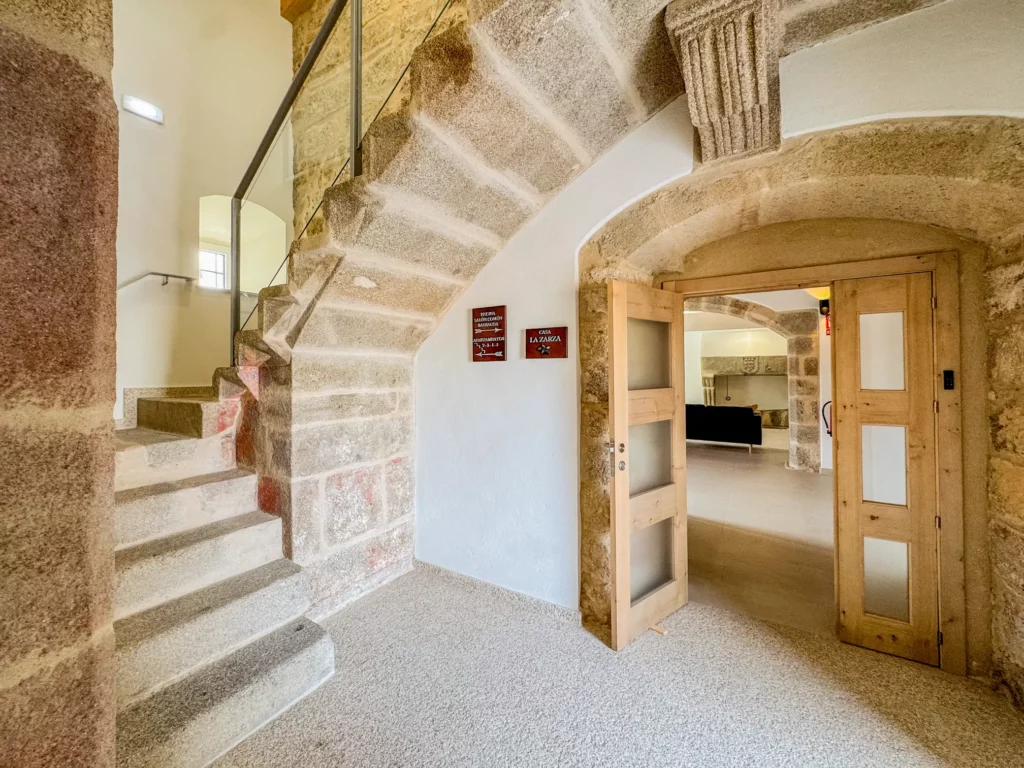
This manor house was a large estate built for agricultural and livestock production, surrounded by orchards, olive groves, and mills. It was built in the 15th century by the Bejarano or Vargas families on the site of an earlier construction, perhaps a Visigoth church, which are abundant in the area. During restoration, some semicircular arch voussoirs, a bull’s-eye window, and a scallop shell were found beneath the floor—elements typical of Visigoth church architecture. The parish church of the village, built around the same time as the house and sharing similar architectural features, might suggest that the owners of the house were also responsible for building the church: perhaps to ease their conscience for having built the manor on the site of an old church, they compensated by erecting the parish temple.
La Zarza and this house gained importance when Gonzalo Pizarro Rodríguez de Aguilar (1446–1522), father of the famous conquistador Francisco Pizarro, came to live here in 1503. Don Gonzalo was nicknamed “El Largo”, though it is unclear whether this was because he was very tall or because he spent money easily—not exactly on extravagances, but also on generous acts. Gonzalo was the son of Hernando Alonso Pizarro, who married Isabel Rodríguez de Aguilar in 1445. Through this marriage, the three Trujillo lineages of the reconquest became linked: Hernando belonged to the Añasco; Isabel, on her father’s side, to the Bejarano; and on her mother’s side, to the Altamirano.
Gonzalo did not own land initially; through his marriage to his cousin Isabel de Vargas y Rodríguez de Aguilar, he acquired his first lands: those of La Zarza—this house, with its orchards, olive groves, and mill. Don Gonzalo and Doña Isabel married in Trujillo in 1503 and lived in this house until 1508, the year of her death.
In 1522, on his deathbed in Pamplona, Don Gonzalo left this house and its orchards and properties to his only legitimate son, Hernando, in his will. Hernando later married Francisca Pizarro Yupanqui, his niece, daughter of his elder brother, the afore mentioned Francisco Pizarro, and an Inca princess. Don Gonzalo never acknowledged Francisco as his son.
Around the mid-16th century, Don Hernando built the palace that now lies in ruins one hundred meters from this house. He did so decades after this house was already in use, which explains why that later construction bears the Pizarro coat of arms and not that of the Orellana.